 Add to Chrome
 Add to Firefox
 Add to Edge
LT2: Linear-Time Looped Transformers
May 20, 2026
Looped Transformers (LT) have emerged as a powerful architecture by iterating their layers multiple times before decoding the final token. However, pairing them with full attention retains quadratic complexity, making them computationally expensive and slow. We introduce LT2 (Linear-Time Looped Transformers), a family of looped architectures that replace quadratic softmax attention with subquadratic, linear-time attention. We study two variants: LT2-linear with linear attention and LT2-sparse with sparse attention. We find that looping uniquely synergizes with these variants: it enables iterative memory refinement in linear attention and progressively expands the effective receptive field in sparse attention. We formalize these benefits theoretically and demonstrate consistent empirical gains across controlled recall, state-tracking, and language modeling tasks. We then explore LT2-hybrid, which combines different attention variants in a looped setting. Two variants are especially promising: LT2-hybrid (GDN+DSA), which interleaves linear and sparse attention to maximize efficiency and matches the standard looped transformer's quality at fully linear-time cost; and LT2-hybrid (Full+GDN), which interleaves GDN with a small fraction of full attention layers to maximize quality, surpassing the standard looped transformer in both performance and efficiency. We also show how to convert a pre-trained LT into an LT2-hybrid model. With about 1B tokens of training, our converted model, Ouro-hybrid-1.4B, outperforms industry-level 1B models and is competitive with industry-level 4B models while retaining the speed benefits of linear-time attention. Together, these results show a clear path toward making looped transformers more scalable and advancing efficient, capable small language models.

ByteFlow: Language Modeling through Adaptive Byte Compression without a Tokenizer
Mar 03, 2026Modern language models still rely on fixed, pre-defined subword tokenizations. Once a tokenizer is trained, the LM can only operate at this fixed level of granularity, which often leads to brittle and counterintuitive behaviors even in otherwise strong reasoning models. We introduce \textbf{ByteFlow Net}, a new hierarchical architecture that removes tokenizers entirely and instead enables models to learn their own segmentation of raw byte streams into semantically meaningful units. ByteFlow Net performs compression-driven segmentation based on the coding rate of latent representations, yielding adaptive boundaries \emph{while preserving a static computation graph via Top-$K$ selection}. Unlike prior self-tokenizing methods that depend on brittle heuristics with human-designed inductive biases, ByteFlow Net adapts its internal representation granularity to the input itself. Experiments demonstrate that this compression-based chunking strategy yields substantial performance gains, with ByteFlow Net outperforming both BPE-based Transformers and previous byte-level architectures. These results suggest that end-to-end, tokenizer-free modeling is not only feasible but also more effective, opening a path toward more adaptive and information-grounded language models.
Spherical Steering: Geometry-Aware Activation Rotation for Language Models
Feb 09, 2026Inference-time steering has emerged as a promising paradigm for controlling language models (LMs) without the cost of retraining. However, standard approaches typically rely on activation addition, a geometric operation that inevitably alters the magnitude of hidden representations. This raises concerns about representation collapse and degradation of open-ended generation capabilities. In this work, we explore Spherical Steering, a training-free primitive that resolves this trade-off through activation rotation. Rather than shifting activations with a fixed vector, our method rotates them along a geodesic toward a target direction, guiding the activation toward the target concept while preserving the integrity of the signal. To further enhance adaptivity, we incorporate a confidence gate that dynamically modulates steering strength based on input uncertainty. Extensive experiments across multiple-choice benchmarks demonstrate that Spherical Steering significantly outperforms addition-based baselines (notably by +10% on TruthfulQA, COPA, and Storycloze), while simultaneously maintaining the model's general open-ended generation quality. This work highlights the value of geometric consistency, suggesting that norm-preserving rotation is a robust and effective primitive for precise inference-time control.
Learning Distribution-Wise Control in Representation Space for Language Models
Jun 07, 2025Interventions in language models (LMs) are applied strategically to steer model behavior during the forward pass. Learnable interventions, also known as representation fine-tuning, aim to apply pointwise control within the concept subspace and have proven effective in altering high-level behaviors. In this work, we extend this approach to the distribution level, enabling the model to learn not only pointwise transformations but also the surrounding regions of the concept subspace. We demonstrate that these methods perform effectively in early layers, with larger standard deviations correlating strongly with improved performance. Across eight commonsense reasoning and seven arithmetic reasoning benchmarks, our distribution-wise interventions consistently outperform pointwise interventions in controllability and robustness. These results illustrate that distribution-wise interventions provide a more comprehensive method for steering model behavior and enabling finer-grained control over language models. The code is at: \href{https://github.com/chili-lab/D-Intervention}{https://github.com/chili-lab/D-Intervention}.
Rethinking Diverse Human Preference Learning through Principal Component Analysis
Feb 18, 2025Understanding human preferences is crucial for improving foundation models and building personalized AI systems. However, preferences are inherently diverse and complex, making it difficult for traditional reward models to capture their full range. While fine-grained preference data can help, collecting it is expensive and hard to scale. In this paper, we introduce Decomposed Reward Models (DRMs), a novel approach that extracts diverse human preferences from binary comparisons without requiring fine-grained annotations. Our key insight is to represent human preferences as vectors and analyze them using Principal Component Analysis (PCA). By constructing a dataset of embedding differences between preferred and rejected responses, DRMs identify orthogonal basis vectors that capture distinct aspects of preference. These decomposed rewards can be flexibly combined to align with different user needs, offering an interpretable and scalable alternative to traditional reward models. We demonstrate that DRMs effectively extract meaningful preference dimensions (e.g., helpfulness, safety, humor) and adapt to new users without additional training. Our results highlight DRMs as a powerful framework for personalized and interpretable LLM alignment.
Knowing When to Stop: Dynamic Context Cutoff for Large Language Models
Feb 03, 2025
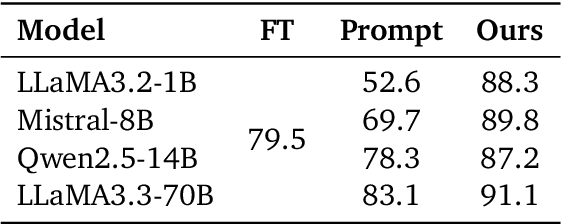

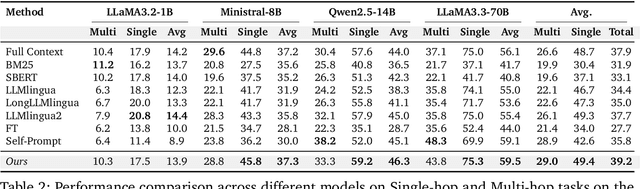
Large language models (LLMs) process entire input contexts indiscriminately, which is inefficient in cases where the information required to answer a query is localized within the context. We present dynamic context cutoff, a human-inspired method enabling LLMs to self-terminate processing upon acquiring sufficient task-relevant information. Through analysis of model internals, we discover that specific attention heads inherently encode "sufficiency signals" - detectable through lightweight classifiers - that predict when critical information has been processed. This reveals a new efficiency paradigm: models' internal understanding naturally dictates processing needs rather than external compression heuristics. Comprehensive experiments across six QA datasets (up to 40K tokens) with three model families (LLaMA/Qwen/Mistral, 1B0-70B) demonstrate 1.33x average token reduction while improving accuracy by 1.3%. Furthermore, our method demonstrates better performance with the same rate of token reduction compared to other context efficiency methods. Additionally, we observe an emergent scaling phenomenon: while smaller models require require probing for sufficiency detection, larger models exhibit intrinsic self-assessment capabilities through prompting.
Language Models are Symbolic Learners in Arithmetic
Oct 21, 2024Large Language Models (LLMs) are thought to struggle with arithmetic learning due to the inherent differences between language modeling and numerical computation, but concrete evidence has been lacking. This work responds to this claim through a two-side experiment. We first investigate whether LLMs leverage partial products during arithmetic learning. We find that although LLMs can identify some partial products after learning, they fail to leverage them for arithmetic tasks, conversely. We then explore how LLMs approach arithmetic symbolically by breaking tasks into subgroups, hypothesizing that difficulties arise from subgroup complexity and selection. Our results show that when subgroup complexity is fixed, LLMs treat a collection of different arithmetic operations similarly. By analyzing position-level accuracy across different training sizes, we further observe that it follows a U-shaped pattern: LLMs quickly learn the easiest patterns at the first and last positions, while progressively learning the more difficult patterns in the middle positions. This suggests that LLMs select subgroup following an easy-to-hard paradigm during learning. Our work confirms that LLMs are pure symbolic learners in arithmetic tasks and underscores the importance of understanding them deeply through subgroup-level quantification.
Unveiling the Spectrum of Data Contamination in Language Models: A Survey from Detection to Remediation
Jun 20, 2024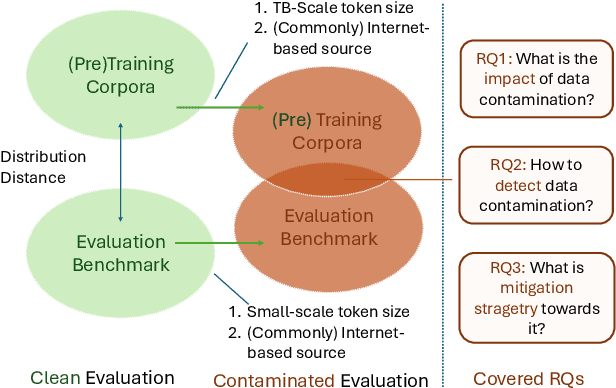


Data contamination has garnered increased attention in the era of large language models (LLMs) due to the reliance on extensive internet-derived training corpora. The issue of training corpus overlap with evaluation benchmarks--referred to as contamination--has been the focus of significant recent research. This body of work aims to identify contamination, understand its impacts, and explore mitigation strategies from diverse perspectives. However, comprehensive studies that provide a clear pathway from foundational concepts to advanced insights are lacking in this nascent field. Therefore, we present a comprehensive survey in the field of data contamination, laying out the key issues, methodologies, and findings to date, and highlighting areas in need of further research and development. In particular, we begin by examining the effects of data contamination across various stages and forms. We then provide a detailed analysis of current contamination detection methods, categorizing them to highlight their focus, assumptions, strengths, and limitations. We also discuss mitigation strategies, offering a clear guide for future research. This survey serves as a succinct overview of the most recent advancements in data contamination research, providing a straightforward guide for the benefit of future research endeavors.
Think Before You Act: A Two-Stage Framework for Mitigating Gender Bias Towards Vision-Language Tasks
May 27, 2024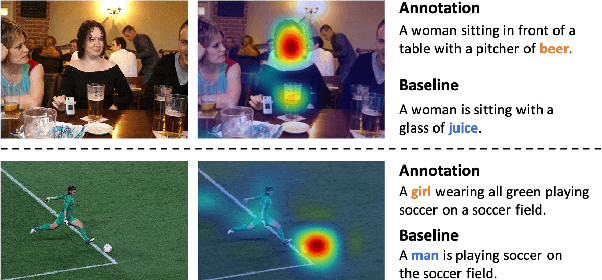
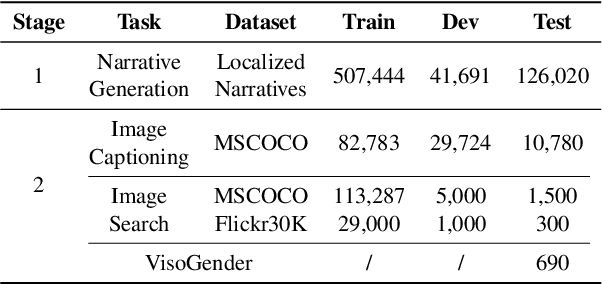
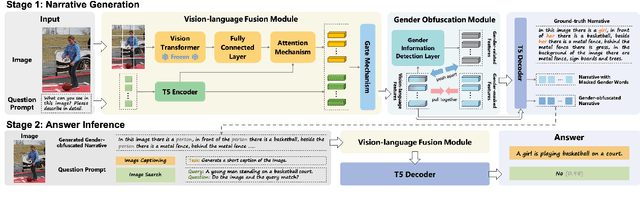

Gender bias in vision-language models (VLMs) can reinforce harmful stereotypes and discrimination. In this paper, we focus on mitigating gender bias towards vision-language tasks. We identify object hallucination as the essence of gender bias in VLMs. Existing VLMs tend to focus on salient or familiar attributes in images but ignore contextualized nuances. Moreover, most VLMs rely on the co-occurrence between specific objects and gender attributes to infer the ignored features, ultimately resulting in gender bias. We propose GAMA, a task-agnostic generation framework to mitigate gender bias. GAMA consists of two stages: narrative generation and answer inference. During narrative generation, GAMA yields all-sided but gender-obfuscated narratives, which prevents premature concentration on localized image features, especially gender attributes. During answer inference, GAMA integrates the image, generated narrative, and a task-specific question prompt to infer answers for different vision-language tasks. This approach allows the model to rethink gender attributes and answers. We conduct extensive experiments on GAMA, demonstrating its debiasing and generalization ability.
MIMIR: A Streamlined Platform for Personalized Agent Tuning in Domain Expertise
Apr 03, 2024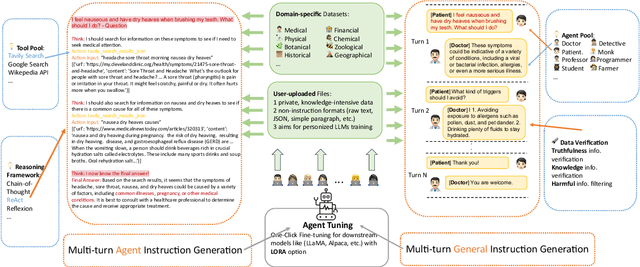
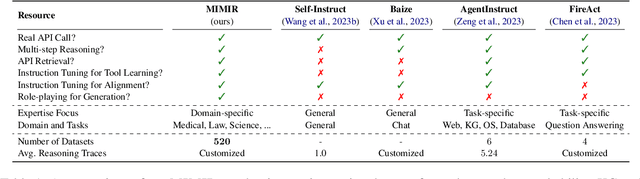
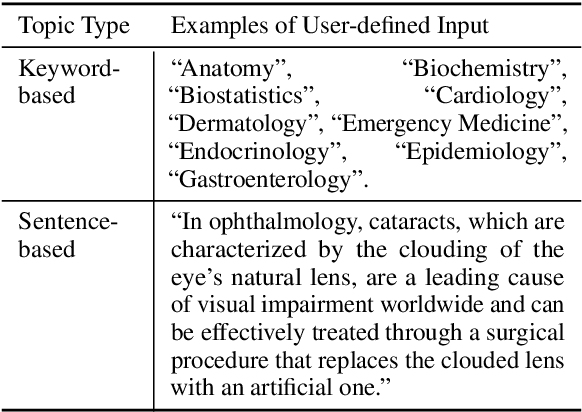
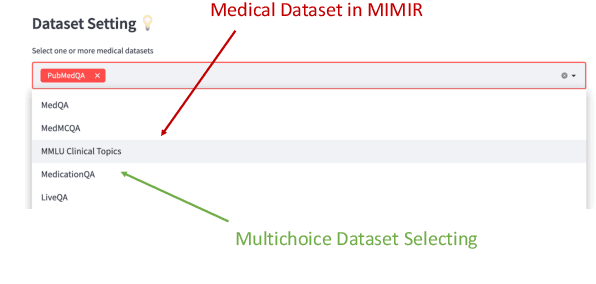
Recently, large language models (LLMs) have evolved into interactive agents, proficient in planning, tool use, and task execution across a wide variety of tasks. However, without specific agent tuning, open-source models like LLaMA currently struggle to match the efficiency of GPT- 4, particularly given the scarcity of agent-tuning datasets for fine-tuning. In response, we introduce \textsc{Mimir}: a streamlined platform offering a customizable pipeline that enables users to leverage both private knowledge and publicly available, legally compliant datasets at scale for \textbf{personalized agent tuning}. Additionally, \textsc{Mimir} supports the generation of general instruction-tuning datasets from the same input. This dual capability ensures that language agents developed through the platform possess both specific agent abilities and general competencies. \textsc{Mimir} integrates these features into a cohesive end-to-end platform, facilitating everything from the uploading of personalized files to one-click agent fine-tuning.